

The Conscious Care Attachment Framework™
Relational science has taught us what matters. This framework helps organizations put it into practice.
Over nearly three decades of working in mental health with children, families, and caregivers, I have repeatedly seen the same challenge: we know a great deal about what children need to develop emotionally healthy relationships, yet translating that knowledge into everyday practice can be difficult.
The science of attachment, relational health, nervous system regulation, co-regulation, reflective caregiving, and Positive Childhood Experiences gives us a stronger understanding of the importance of relationships in child development. The question that has guided the development of the Conscious Care Attachment Framework is more practical: How do we help adults use this knowledge in the ordinary moments when relationships are built?
Relational science has taught us what matters. CCAF helps organizations put it into practice.
The Conscious Care Attachment Framework™ is an attachment-informed relational health implementation framework that strengthens adult capacity, translates relational science into accessible everyday practice, and builds relational continuity across the environments surrounding children.
CCAF brings together adult internal capacity, caregiver-child relational practice, workforce capacity, accessible relational implementation, and relational continuity across environments. It translates complex research into something a home visitor, parent, foster caregiver, teacher, Child Life Specialist, family advocate, or grandparent can use in everyday human interactions.
The Central Proposition of CCAF
CCAF proposes that strengthening adults' internal capacity increases their ability to engage in responsive relational practice. It also proposes that complex relational science can be translated into accessible, repeatable relational experiences, and that greater consistency in relational practices across the environments surrounding children may strengthen children's experiences of relational safety, predictability, connection, and support.
CCAF is not a replacement for evidence-based programs already serving children and families. It is designed to help organizations translate relational science into everyday practice and strengthen the work already taking place within family-serving systems.
At the heart of the framework is a principle that has emerged from my years of working with children, families, caregivers, and helping professionals: when we strengthen the capacity of the adults surrounding children, we create more opportunities for children to experience the safe, responsive, predictable, and connected relationships that support healthy development.
From Research to Relationship
CCAF has tangible translation tools.
The Cards translate science into things adults and children actually do together.
The Journal addresses what happens within the adult.
Professional learning supports the workforce.
The framework and curriculum connect those pieces across systems.

1. Adult Internal Capacity
I define Adult Internal Capacity as the reflective, emotional, relational, and regulatory resources an adult has available to remain present and responsive within a relationship.
This includes our ability to notice our own emotional state, recognize triggers and relational patterns, regulate physiological and emotional activation, tolerate another person's distress, reflect before reacting, repair relational ruptures, and remain emotionally available during challenging interactions.
One central idea in CCAF is that knowing what a child needs and having the capacity to provide it in a difficult moment are not always the same. An adult may understand attachment, emotional regulation, or responsive caregiving and still become overwhelmed, activated, exhausted, or disconnected. This is why CCAF intentionally includes the adult's internal experience rather than focusing exclusively on parenting behavior or child behavior.
The Reparenting the Parent Journal™ supports this dimension by helping adults reflect on their own experiences, emotions, relational patterns, triggers, attachment histories, and capacity for regulation and repair.

2. Caregiver-Child Relational Practice
Children do not experience attachment theory. They experience relationships.
Caregiver-Child Relational Practice describes what happens between an adult and child through repeated interactions involving attunement, responsiveness, co-regulation, connection, emotional communication, play, predictable caregiving, boundaries, repair, support, and appropriate opportunities for autonomy.
Within CCAF, adults don't simply learn about relational health. Adults and children practice and experience it together. The Conscious Care relational toolkit was developed for this purpose. These experiences give adults and children practical opportunities to practice the relational processes that research shows matter.
3. Workforce Capacity
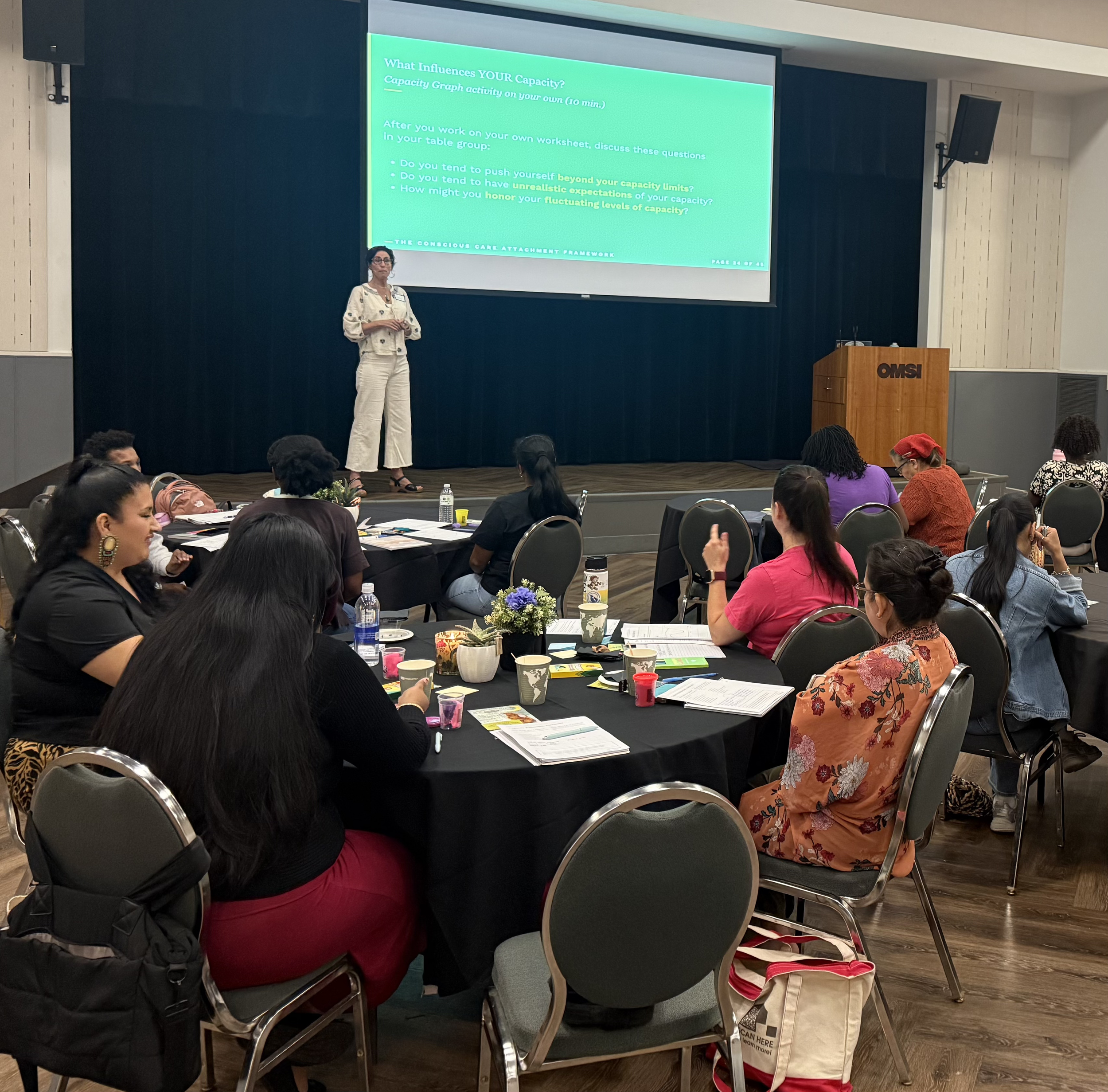
My work with professionals has also led me to believe we cannot separate workforce wellbeing and capacity from the relational experiences we hope professionals will create for children and families.
Home visitors, teachers, family advocates, therapists, social workers, Child Life Specialists, early childhood professionals, Parent Café facilitators, and other helping professionals bring their own nervous systems, histories, stressors, and relational capacities into their work.
I therefore define Workforce Capacity as professionals' ability to sustain the reflective, emotional, relational, and regulatory resources necessary for relationally responsive practice.
This is why workforce capacity is part of CCAF rather than a separate conversation about self care. The adults supporting families also need environments and practices that support their capacity to remain reflective, practice self attunement, remain regulated and emotionally available, and stay connected to the meaning of their work.
My Sustaining the Heart of the Helper work sits within this dimension of the framework.
4. Accessible Relational Implementation
One of the principles underlying CCAF is simple: the science may be complex; the practice should not have to be. We make it accessible for everyone.
Families should not need graduate education, clinical training, or extensive knowledge of attachment theory or neuroscience to create meaningful relational experiences with their children.
I developed CCAF to translate complex relational science into practical experiences for ordinary family life. These experiences are intentionally accessible, brief, and adaptable because the adults supporting children are often already carrying significant demands.
I describe many of these experiences as relational micro rituals: brief, intentional, repeatable experiences embedded within everyday interactions that create opportunities for connection, regulation, emotional awareness, communication, play, predictability, support, or repair.
The activity itself is not the ultimate goal. The relational experience created through the activity is what matters. Micro rituals allow relational practice to occur in moments that already exist within family and community life. Presence over perfection. Micro moments matter.
5. Relational Continuity Across Environments
Children develop within an ecology of relationships. Their relational experiences do not occur only at home or within one program.
Children move between families, early learning settings, schools, healthcare environments, behavioral health services, child welfare systems, family support programs, and community spaces. Each environment contributes to the child's experience of adults, relationships, emotional safety, and support.
Within CCAF, I use Relational Continuity Across Environments to describe the degree to which children encounter compatible experiences of relational safety, responsiveness, regulation, predictability, connection, and repair across the environments surrounding them.
This does not mean every adult uses the same intervention or behaves in the same way. It means that children repeatedly encounter adults who understand and support core relational needs.
CCAF is specifically designed to complement existing programs rather than replace them. A home visitor, therapist, teacher, Child Life Specialist, family advocate, Parent Café facilitator, and caregiver may work within very different systems while still sharing an understanding of relational safety, regulation, connection, and repair.
Environments
Testimonials
Every grant begins with a vision.
Successful implementation begins with the adults who bring that vision to life.
If your organization is looking for practical, evidence informed strategies to strengthen workforce development, caregiver education, and family engagement, we'd love to explore how the Conscious Care Attachment Framework™ can support your goals.